MIG Welding Basics for Beginners: Setup and First Welds
Set up a MIG welder correctly: polarity, shielding gas, wire stickout, starting settings by thickness, and how to read the arc so your first welds hold.
 Save
Getting good MIG (GMAW) welds comes down to four things: the right polarity for your wire, the right shielding gas at a steady flow, a short consistent wire stickout, and voltage and wire speed that match your metal thickness. Set those up first, practice on scrap, and listen to the arc.
Quick answer
- Solid wire with gas: torch on positive (+), work clamp on negative (-).
- Mild steel gas: 75% argon / 25% CO2. Aluminum: pure argon.
- Stickout: roughly 10 to 15 mm (about 3/8 to 5/8 in) for solid wire.
- Start from your welder’s settings chart, change one setting at a time and test on scrap of the same metal.
- Wear a proper welding helmet and gloves, and keep the area free of anything flammable.
What you need
| Item | What it does | Notes |
|---|---|---|
| MIG welder | Feeds wire and supplies current | Check the chart inside the wire door |
| Solid wire (such as ER70S-6) | Filler for steel with gas | Contact tip must match wire diameter |
| Shielding gas and regulator | Protects the molten pool | C25 for mild steel |
| Welding helmet, gloves, jacket | Protect eyes and skin | Flip the helmet down before striking the arc |
| Wire brush or grinder | Cleans the metal | MIG needs clean metal |
| Clamps and scrap steel | Hold work, practice | Use the same thickness as your project |
Work in a ventilated space, away from solvents, sawdust and other fuel. Keep a fire extinguisher within reach.
Step 1: Set the polarity
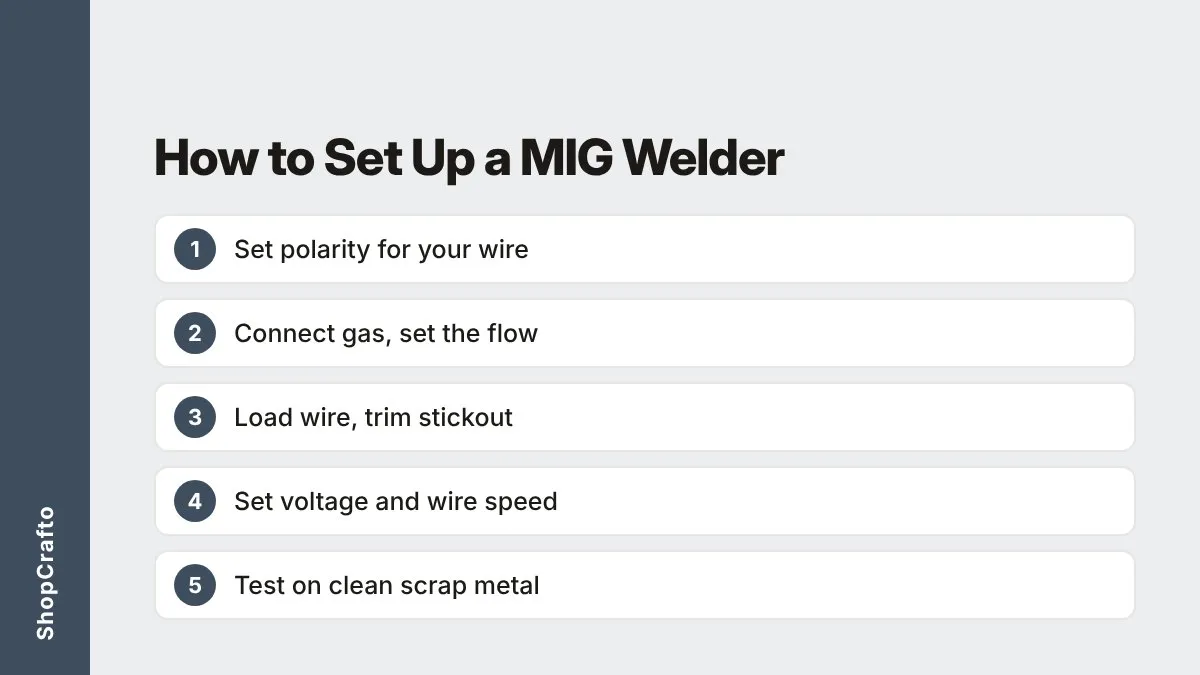
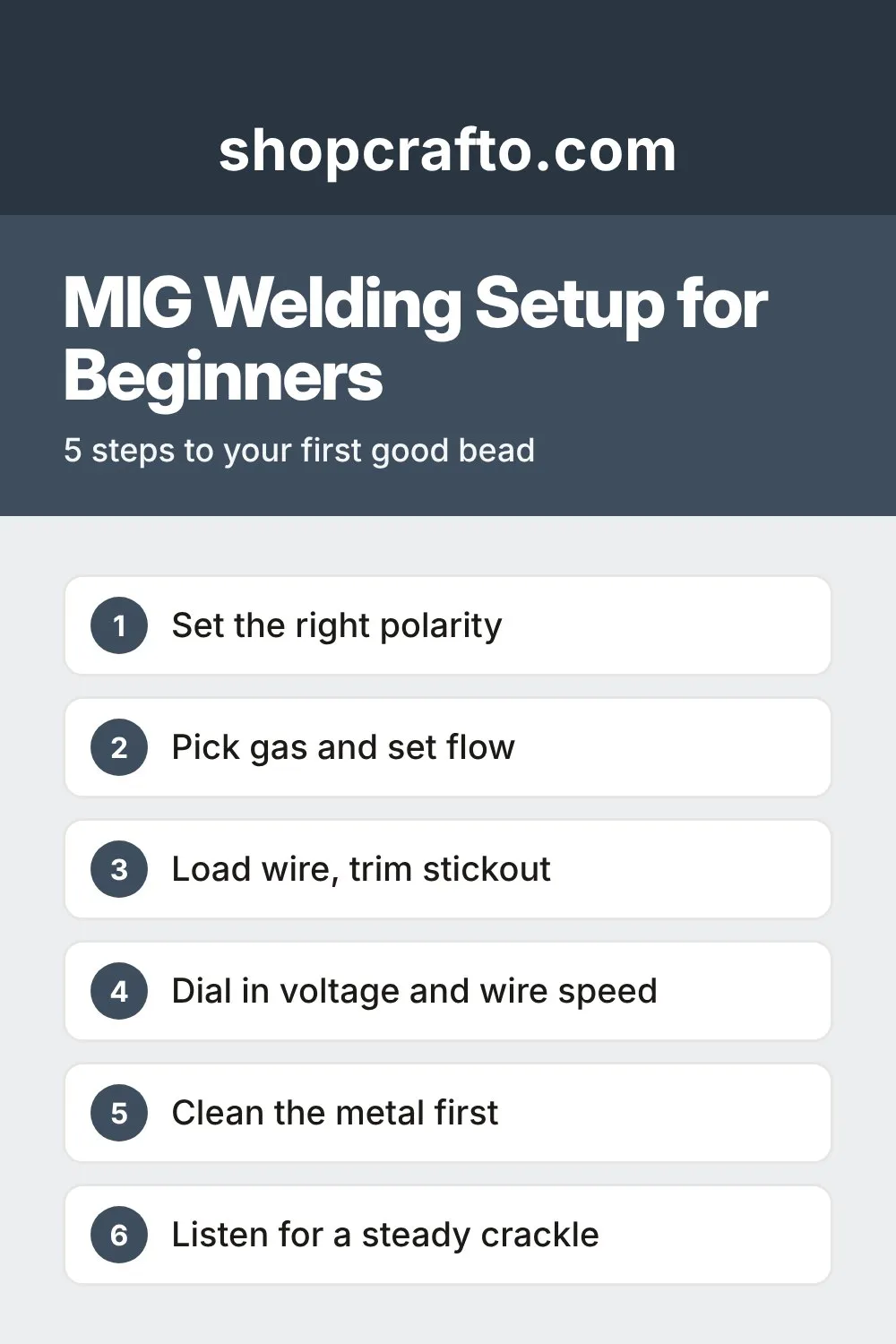
Most MIG welders are shipped set for gas-shielded solid wire. That is called DCEP (electrode positive): the torch cable goes to the positive (+) socket and the work clamp to the negative (-) socket. Gasless flux-cored wire needs the reverse, so you swap the leads. Wrong polarity gives a cold, porous weld with heavy spatter.
Also check that the work clamp is on bare metal on or near the workpiece. A poor earth connection means unstable arcs or no arc at all.
Step 2: Choose and set the gas
| Metal | Typical gas | Notes |
|---|---|---|
| Mild steel | 75% argon / 25% CO2 (C25) | Straight CO2 also works |
| Stainless | Argon-rich mix with a little CO2 | Avoid C25 |
| Aluminum | Pure argon | Needs a PTFE liner and U-groove rolls |
Flow rates differ between sources. One manufacturer suggests roughly 8 to 12 liters per minute, while another lists 10 to 15 L/min indoors and more outdoors. Start in the low-middle of that range and follow your welder’s manual. Too little flow lets air in, and very high flow causes turbulence that also causes porosity. Outdoors, wind blows gas away, so use a windbreak instead of just turning the gas up.
Step 3: Load the wire and tune tension
- Match the drive roll groove to the wire: V-groove for solid steel wire, U-groove for aluminum and flux-cored.
- Match the contact tip to the wire diameter exactly.
- Feed wire through until it sticks out of the nozzle about 5 cm (2 in).
- Adjust drive roll tension just enough that the wire feeds without slipping. Too much tension flattens the wire and can cause jams.
- Trim the wire so stickout is about 10 to 15 mm before welding.
Step 4: Dial in settings
Wire feed speed (WFS) controls current, penetration and how much filler goes in. Voltage controls arc length and bead shape: higher voltage gives a wider, flatter bead. Change one at a time, starting with wire speed.
One distributor’s example starting points for mild steel with 0.8 to 0.9 mm solid wire and C25 gas are below. They are starting points only, so test on scrap first.
| Steel thickness | Wire | Voltage | Wire speed |
|---|---|---|---|
| 1.6 mm | 0.8 mm | 17 to 19 V | 4.5 to 5.5 m/min |
| 2.0 mm | 0.8 mm | 18 to 20 V | 5.5 to 6.5 m/min |
| 3.0 mm | 0.8 to 0.9 mm | 19 to 21 V | 6.5 to 8.0 m/min |
| 4.0 mm | 0.9 mm | 20 to 22 V | 7.5 to 9.5 m/min |
Your welder will probably have its own chart inside the door. Where it differs, trust the chart for your machine and wire.
Step 5: Run your first welds
- Clean the metal with a wire brush or grinder until it is bright.
- Clamp the work, attach the earth clamp, and check the gas is flowing.
- Hold the torch with a push angle of about 10 to 15 degrees. For a fillet (T-joint), aim about 45 degrees to the plates. For a flat butt joint, hold about 90 degrees.
- Flip the helmet down, squeeze the trigger and move steadily along the joint, keeping stickout consistent.
- Listen: a steady crackle means you are close. Loud popping means wire speed is too low or voltage too high. Harsh buzzing means wire speed is too high for the voltage.
- Let the work cool before handling it. Wear gloves, because the wire and metal are hot.
Gasless flux-cored wire is dragged (pulled) rather than pushed, and often wants a little more stickout, around 15 to 20 mm.
Common mistakes and fixes
| Problem | Likely causes | Fix |
|---|---|---|
| Porosity (holes) | Dirty metal, gas leak, wind, wrong gas | Clean, check hoses, block drafts |
| Heavy spatter | Voltage too low, wrong polarity, long stickout | Check leads, trim wire |
| Bird-nesting | Blocked tip, kinked liner, tight rolls | Replace the tip, ease tension |
| Burn-through | Too hot, too slow | Lower voltage, speed up |
| Lack of fusion | Too fast, settings too low, poor angle | Slow down, raise settings |
| Unstable arc | Worn tip, bad earth, low gas | Replace tip, clean clamp spot |
Other habits help too: keep a steady hand speed, avoid rewinding used wire spools, and replace worn contact tips.
When to get help
If you plan to weld structural parts, trailers, pressure vessels or anything that carries people or loads, learn from a qualified instructor and have the work inspected. A community college welding class is a good next step. Stop and get the equipment checked if you see damaged cables, gas leaks or smell burning insulation.
Sources
 Save
Frequently asked questions
What gas do I use for MIG welding mild steel?
The usual choice is a mix of 75% argon and 25% CO2, often sold as C25. Straight CO2 also works on steel but tends to be spatterier. Aluminum needs pure argon.
Which way do the polarity leads go?
For solid wire with gas, the torch connects to positive (+) and the work clamp to negative (-). Gasless flux-cored wire is the reverse. Your welder's manual and door chart show the exact sockets.
What should a good MIG weld sound like?
A steady, even crackle, often compared to bacon frying. Loud popping points to wire speed too low or voltage too high, while harsh buzzing suggests wire speed too high for the voltage.
Why are there holes in my weld?
Holes (porosity) usually come from contaminated metal, a gas leak, wind blowing the gas away, the wrong gas, or too much stickout. Clean the metal, check the gas flow and block drafts.